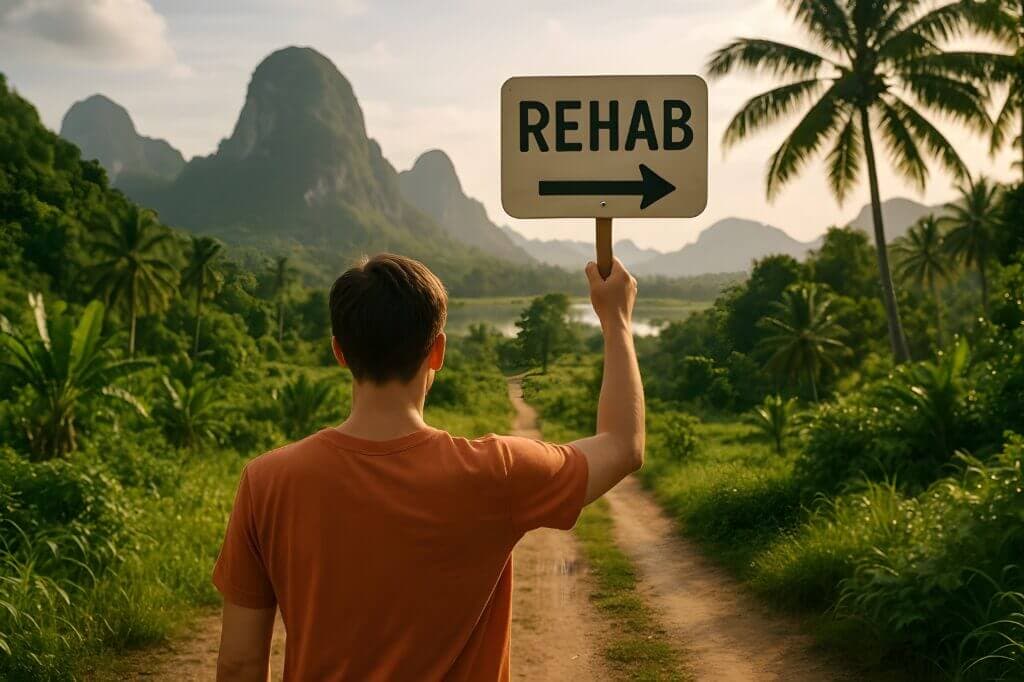
Private residential rehab in Thailand generally costs a fraction of equivalent private treatment in Australia, the UK, or the US, while allowing for longer program lengths at a similar or lower total price. International clients weighing this option are really deciding between three variables at once: total cost once hidden extras are counted, clinical depth relative to price, and whether a facility abroad can safely manage detox and any co-occurring conditions. Which of these three matters most depends on the specific situation.
Rehab in Thailand refers to private residential addiction treatment programs, mostly concentrated in Chiang Rai and Chiang Mai, combining medically supervised detox with individual and group therapy over stays of four weeks or longer. All licensed programs carry Ministry of Public Health approval, but licensing is a safety minimum, not proof of clinical depth. The detail that changes outcomes most is verified hospital transfer capacity and psychiatric coverage, which vary sharply between facilities charging similar headline prices.
How Does Rehab in Thailand Compare to Home-Country Treatment?
Rehab in Thailand typically costs a fraction of equivalent private treatment in Australia, the UK, or the US, mainly because lower operating costs allow longer stays at a similar total price. Home-country private programs offer easier handoff to existing local aftercare providers; Thailand-based programs offer more complete separation from the environment that sustains active use.
What Private Residential Treatment in Thailand Actually Involves
Private residential programs in Thailand generally combine three core components: medically supervised detox when needed, structured individual and group therapy, and a fixed-length stay in a residential facility physically separated from the client’s home environment. Industry pricing surveys, including those published by Bookimed and Recovery.com, place standard Thailand-based programs in roughly the $3,000 to $9,000 per month range, with higher-intensity programs charging more for daily physician access and a lower client-to-therapist ratio.
A lower price does not automatically signal lower clinical quality, and a higher price does not automatically signal better outcomes. What actually separates programs at different price points is staffing depth: how many hours of individual therapy a client receives per week, whether a psychiatrist is on-site or reachable only by referral, and whether detox is supervised by nursing staff around the clock or checked periodically. These structural differences affect safety and outcomes more than the headline monthly figure does, and they are rarely visible without asking directly.
Most accredited programs follow a non-12-step model, a 12-step model, or a blend of both. This distinction shapes daily structure and the framework used in group sessions, but it has less bearing on medical safety than staffing ratios and on-site psychiatric coverage do. Clinicians who work across both models generally agree that consistency of structure matters more to early recovery than which framework a program is built on.
How Thailand’s Rehab Pricing Landscape Actually Breaks Down
Published pricing across Thailand-based programs varies more widely than the country-level averages suggest, and the spread itself is informative. Bookimed’s clinic data puts standard drug-addiction treatment at roughly $5,000-$9,000 for a program, with alcohol-focused treatment running lower, around $2,200-$5,000. Recovery.com’s guidance splits the market into two tiers: standard programs at $3,000-$7,000 per month built around group therapy and core individual sessions, and higher-tier facilities at $10,000-$20,000 or more per month once daily physician rounds, a lower client ratio, and psychiatric evaluation are added. Rehabs Asia reports a similar split, citing roughly $10,000 for a 28-day standard inpatient stay and $15,000 or more at the luxury end. Some providers advertise a flat, all-inclusive monthly rate rather than a tiered structure, positioning cost savings against Western pricing as the primary selling point rather than itemizing what specifically drives the difference.
This spread exists because three cost drivers move independently of each other: accommodation standard (shared versus private rooms), clinical staffing (group-only versus a documented ratio of individual therapy hours), and medical infrastructure (periodic nursing checks versus round-the-clock coverage with an on-call psychiatrist). A program can be inexpensive because it has genuinely lean but adequate staffing for a low-complexity case, or inexpensive because it is under-resourced for a case that actually needs more oversight – and from the outside, a headline price alone cannot distinguish between the two. Asking a facility to itemize its staffing model against these three drivers, rather than accepting a single flat number, is what actually resolves the ambiguity.
Extended stays change this arithmetic further. Because Thailand-based facilities generally price by fixed program length rather than by billable therapy hour, a client who needs 90 days instead of 30 usually pays a lower effective daily rate for the longer commitment, whereas home-country private programs often charge close to the same daily rate regardless of length. This is one of the more under-discussed reasons the total cost gap between Thailand and home-country private care widens as the clinically recommended length of stay increases, rather than staying constant.
Thailand vs Home-Country Rehab: Weighing the Real Differences
The comparison below sets out where private treatment in Thailand structurally differs from private and public options at home. Cost figures for home-country private care vary widely by clinic and country and are not repeated here as fixed numbers; multiple industry sources place them at several times the equivalent Thailand-based program for a comparable length of stay.
Neither column is categorically better. Home-country programs make aftercare integration easier because the treating team and the outpatient team can be the same health system. Thailand-based programs trade that convenience for a longer stay and more complete separation from the environment that sustains the addiction, at a lower total cost for an equivalent length of care.
Matching the Program to the Situation
Once the general comparison is clear, the decision narrows to a handful of specific questions that a comparison table cannot answer on its own.
Cost and what it actually includes. A quoted monthly figure rarely covers everything. Medication costs beyond standard detox, and any in-patient hospital care if it becomes necessary, are typically billed separately from the core program fee at most facilities, Thailand-based or otherwise. A detailed breakdown of what is and is not included is covered in this guide to rehab cost in Thailand.
Visa requirements. A standard tourist entry may cover a 30-day stay, but longer programs commonly require a different visa category, and the application process can take time to arrange. The specific requirements are detailed in this visa requirements overview for rehab in Thailand.
Insurance. Domestic health insurance rarely covers international residential addiction treatment, and confirming this in advance avoids a wasted claim-processing delay during an already time-sensitive decision. This breakdown of insurance realities for international clients covers what is and is not typically reimbursable.
Admissions process. Programs generally require a clinical intake call before accepting a client, not just a payment. This step exists to confirm the facility can actually manage the person’s specific substance use and any co-occurring conditions. This overview of how international admissions work walks through the sequence.
Length of stay. Clinical guidance generally favors longer stays for repeated relapse or co-occurring psychiatric conditions, but the right length also depends on budget and travel logistics. This guide to length-of-stay planning sets out how that tradeoff is usually resolved.
If a client has already tried outpatient treatment or a short domestic program without lasting results, and cost is the main barrier to a longer stay: request an itemized quote from at least two accredited facilities before deciding on price alone.
If a client’s situation involves co-occurring psychiatric conditions or a prior relapse after completing a full program, Siam Rehab in Chiang Rai maintains an on-site psychiatric clinic seven days a week alongside daily telehealth access – confirming this kind of coverage in writing before committing is the single most useful verification step for a complex case.
Whichever program is under consideration, the same underlying question applies: does the facility’s actual staffing and medical coverage match what the client’s specific situation requires, not just what the marketing describes. Confirming this in writing before paying a deposit is the one action that prevents most of what goes wrong afterward.
What the Wrong Choice Costs
Choosing a program on price alone, without verifying medical capacity, creates a specific and avoidable risk: a facility without a documented hospital transfer agreement or 24/7 nursing may not be able to manage a complication safely, and international location makes that harder to correct once a client has already arrived. Requesting the written transfer agreement and confirming which hospital is named is a direct way to rule this out before travel, and it applies equally to facilities in Thailand and elsewhere. Details on what to verify are covered in this guide to medical clearance before rehab.
The reverse assumption is just as common and just as unreliable: assuming that because a program is international, or costs more, it must therefore be clinically stronger. Neither price nor location is a substitute for verifying staffing ratios and medical oversight directly. Families who skip this step and rely on cost or geography as a proxy for quality are the ones most likely to discover a gap in care after a client has already arrived and treatment has begun. A closer look at whether the cost difference actually holds up is available in this analysis of whether overseas rehab is genuinely cheaper.
A second, quieter risk sits in extension and refund terms rather than in the headline price. Programs that price by fixed block (30, 60, or 90 days) commonly apply different refund percentages depending on how many days into the stay a client leaves, and an extension mid-program sometimes reverts to a different daily rate than the one quoted for a longer stay booked upfront. Confirming both the refund schedule and the extension pricing in writing before the first payment removes a source of financial disagreement that otherwise tends to surface at the worst possible moment – partway through treatment, when the client and family are least equipped to negotiate calmly.
Frequently Asked Questions
Which country has the best rehab for addiction treatment?
No single country holds a universal advantage. Countries with well-established private rehab sectors, including Thailand, the US, and parts of Europe, all have both strong and weak individual facilities. Quality depends on the specific program’s licensing, staffing ratios, and medical oversight rather than the country itself.
How much does rehab in Thailand typically cost?
Standard private residential programs in Thailand commonly fall in the $3,000 to $9,000 per month range, with higher-intensity programs costing more for greater staffing depth. A full breakdown of what drives the price at each tier is available in this cost guide.
Is rehab in Thailand safe and properly accredited?
Licensed facilities operate under Thailand’s Ministry of Public Health, and some hold additional accreditation from bodies such as the Healthcare Accreditation Institute. Licensing confirms a safety baseline; it does not by itself confirm staffing depth or psychiatric coverage, which still need to be verified directly.
What does the price of a program typically include?
Core fees generally cover accommodation, meals, therapy sessions, and standard detox supervision. Medication costs beyond standard detox and any hospital-level medical care are typically billed separately from the base program fee, regardless of which facility or country is chosen. Requesting a written, itemized breakdown before paying any deposit is the most reliable way to avoid a mid-treatment budget surprise later.
How long should a rehab program be?
Four weeks is the common minimum, but clinical guidance often favors longer stays for repeated relapse or co-occurring conditions. The appropriate length depends on prior treatment history, complexity, and budget, not a single fixed rule. See this length-of-stay planning guide for how that decision is typically made.
Ready to Compare Your Options Before Committing to a Program?
Siam Rehab’s admissions team can walk through cost, timing, and clinical fit for your specific situation.