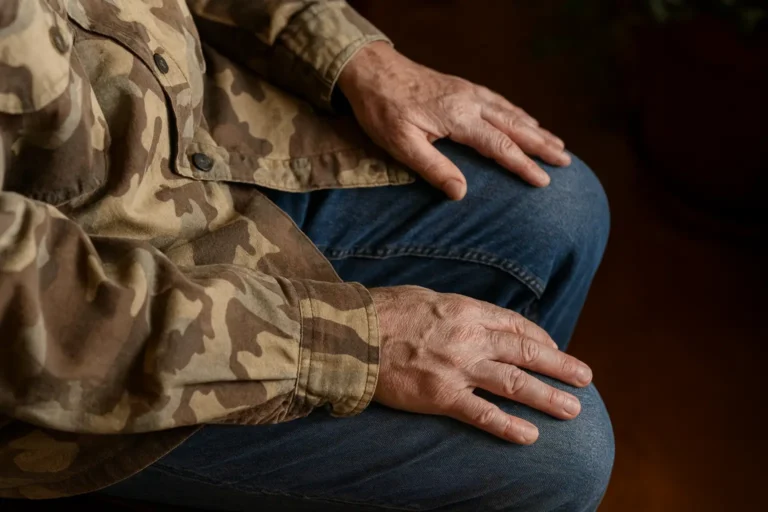
Many veterans notice their drinking or drug use changed after the injury – not after a specific deployment or traumatic event, but after the concussion or blast exposure that their medical record may or may not fully document. The change is often gradual and hard to explain: more alcohol needed to sleep, less ability to stop once started, faster irritability when things do not go as expected. This page explains what is happening neurologically, why it matters for treatment, and what a program that actually addresses it looks like.
TBI and addiction in veterans are linked by a specific neurological mechanism that most treatment programs do not address directly. Blast injury damages dopaminergic pathways in the brain, reducing baseline reward signaling and increasing impulsivity – which raises relapse risk independent of trauma history or psychological factors. When combined with the sleep disruption that TBI causes, this creates a physical pathway to alcohol and sedative dependence that standard addiction treatment alone cannot resolve.
Is This About Your Brain, Not Just Your History?
The pattern worth recognizing is specific. Substance use that increased after a head injury rather than gradually over years or after a specific event. Difficulty stopping despite genuine motivation and repeated attempts. Relapse that follows periods of poor sleep, cognitive overload, or too many competing demands in a single day – rather than emotional triggers or exposure to people and places associated with past use. Substances used primarily to sleep, reduce head pressure, or quiet mental static rather than to manage memories or avoid feelings.
This pattern looks like addiction on the surface – and it is. But it is also the predictable result of a brain working harder than it should have to just to get through an ordinary day and reaching for the most available form of relief.
Many veterans in this situation have been through standard addiction treatment one or more times. They engaged, they tried, and the results did not hold. The explanation given was usually about motivation or commitment. A more accurate explanation, in a significant number of cases, is that the neurological component was never identified or treated. Addressing substance use without addressing what drives it from inside the brain produces exactly the outcomes they experienced.
What Blast Injury Does to the Brain’s Reward System
Blast waves do not always leave visible damage on standard imaging. The injury is often diffuse – spread across the white matter tracts that connect different regions of the brain rather than concentrated in one identifiable location. This is why many veterans with blast-related TBI passed initial screenings and were cleared for duty or discharge without a formal diagnosis.
What diffuse axonal injury does to the reward system is more specific. It disrupts dopaminergic pathways – the circuits that regulate motivation, impulse control, and the brain’s capacity to experience normal satisfaction from everyday activities. When those pathways are damaged, the brain’s baseline reward signal drops. Substances produce a stronger relative effect than they would in an uninjured brain, and the threshold for “enough” keeps moving upward. Research examining veterans who sought treatment specifically for TBI-related symptoms – including a Stanford study on neurological outcomes – found significant impairment in areas directly linked to addiction vulnerability that existed independently of PTSD or trauma history.
Marcus served three deployments and came home from his third one different in ways he could not fully describe. His drinking increased steadily over the following two years. He had no single traumatic event he could point to, which made PTSD-focused treatment feel like it was addressing someone else’s problem. Three programs and two relapses later, a neurological assessment identified blast-related TBI that had never been formally documented. The previous treatment had consistently addressed the symptom without knowing what was driving it.
The Sleep Connection Between TBI and Substance Dependence
Identifying the specific sleep problem that TBI causes matters because it explains one of the most common and least recognized paths to alcohol and benzodiazepine dependence in veterans.
TBI disrupts sleep architecture – specifically the slow-wave and REM phases responsible for emotional regulation and memory consolidation. Veterans with blast injury often describe being exhausted but unable to stay asleep, or waking repeatedly through the night without a clear reason. This is not anxiety-driven insomnia. It is neurological disruption of the mechanisms that produce restorative sleep.
Alcohol and sedatives force sleep onset and reduce nighttime waking. They work, at least at first. For a veteran who has been running on fragmented sleep for months and finally finds something that produces several consecutive hours of rest, the connection between the substance and the relief is immediate and real. Physical dependence develops from what began as a practical response to a medical problem. By the time the dependence is recognized as a problem, the original sleep disruption – and its neurological cause – has typically been overlooked entirely in any discussion of what drove the substance use in the first place.
Why Standard Rehab Formats Work Against TBI Veterans
The failure is in the design, not the person. Standard residential programs typically run six to eight hours of daily group sessions – each one requiring sustained attention, social processing, and emotional regulation in a changing group environment. For a brain with intact executive function, this level of daily demand builds capacity over time. For a brain managing TBI-related cognitive fatigue, each session depletes the resources available for the next one.
By late afternoon, a veteran in this situation has less capacity for self-regulation than they started with that morning. That is when cravings are strongest. That is when behavioral management is hardest. The program is producing the conditions most likely to generate the behavior it is trying to treat – and when things go wrong, the explanation tends to focus on the veteran’s engagement rather than the program’s daily load.
If your substance use increased after a head injury rather than gradually over years, and standard treatment programs have not held across multiple attempts: the neurological component has likely not been formally assessed or integrated into the treatment plan. A program that adjusts its daily demands based on cognitive capacity is a materially different category of care from one that runs the same schedule for every client.
If you are currently in a program and notice that your regulation worsens rather than improves as the day progresses: that pattern is clinically meaningful and worth raising directly with the treatment team.
What Integrated Treatment for TBI and Addiction Actually Requires
The question to ask any program is not whether they treat veterans. It is whether the daily schedule adjusts based on cognitive fatigue – and who makes that call in real time.
Programs that genuinely integrate TBI management with addiction treatment operate differently at the level of daily structure. Scheduling matches cognitive capacity rather than an institutional template. Staff who work with a veteran daily are trained to recognize early fatigue before it becomes dysregulation and to adjust session demands accordingly. Sleep is treated as a clinical priority from the first day of medical detox rather than a side effect to be managed later. The brain injury and the substance use are addressed in parallel – because treating one while leaving the other intact produces the relapse pattern that many TBI veterans know well.
There is a second issue worth naming directly. Many veterans with TBI have never received a formal diagnosis. Symptoms have been attributed to PTSD, moral injury, or adjustment difficulties for years. A program that screens for TBI at admission – rather than assuming a neurologically intact baseline – treats a more accurate picture of the person. This changes what therapy looks like, how much of it happens in a single day, and how progress is measured.
FMP Coverage for TBI-Related Substance Use
TBI sustained during service is typically classified as service-connected. Substance use that developed as a documented consequence of a service-connected condition – including TBI – can qualify for Foreign Medical Program coverage abroad.
Eligibility depends on the veteran’s specific disability rating, the documentation linking the substance use to the service-connected condition, and how the claim is prepared. It is not automatic. But for veterans who have assumed that residential treatment abroad is financially out of reach, verifying FMP eligibility before ruling it out takes one conversation and costs nothing.
Siam Rehab works directly with the Foreign Medical Program and handles billing with the VA, meaning eligible veterans do not pay upfront or manage reimbursement paperwork independently. Full eligibility information, what FMP covers, and the steps for verifying coverage are on the veteran addiction treatment page.
Frequently Asked Questions
How does TBI cause addiction in veterans?
Blast injury disrupts dopaminergic pathways – the brain circuits that regulate impulse control and reward signaling. When these pathways are damaged, the brain’s baseline reward signal drops and impulsivity increases, raising relapse risk independently of trauma history or psychological factors. Combined with the sleep disruption TBI causes, this creates a neurological route to substance dependence that exists alongside – and separate from – any PTSD or coping-related drivers.
What are the signs of TBI in veterans?
Common signs include difficulty concentrating, faster irritability than before the injury, problems with memory and word retrieval, sensitivity to noise or light, persistent headaches, and fragmented sleep. Many of these overlap with PTSD symptoms, which is why TBI frequently goes undiagnosed in veterans already receiving mental health treatment. Substance use that increased specifically after a head injury rather than after deployment is often a signal worth formally investigating.
Can TBI and addiction be treated at the same time?
Yes – and clinical evidence consistently shows that treating them together produces better outcomes than addressing them in sequence. Treating addiction without addressing the neurological factors that drive it leaves the primary cause in place. Treating TBI symptoms without addressing substance use leaves the person managing a brain injury while still dependent on substances that slow neurological recovery and worsen impulse regulation.
Does the VA cover TBI-related addiction treatment abroad?
TBI sustained in service is typically service-connected. Substance use that developed as a consequence of a service-connected TBI may qualify for Foreign Medical Program coverage for treatment abroad. Eligibility depends on the veteran’s specific rating and how the claim is documented. Verifying eligibility directly – rather than assuming treatment abroad is not covered – is the recommended first step before making a decision about programs.
Why do veterans with TBI struggle with standard rehab?
Standard programs run dense daily schedules that deplete cognitive resources faster than a TBI-affected brain can recover them between sessions. By the time the day’s most demanding regulatory requirements arrive – typically late afternoon and evening – a veteran with TBI has less capacity to manage them than they started with. This is a design problem, not a motivation problem, and it produces predictable outcomes regardless of how committed the veteran is.
What substances do TBI veterans most commonly misuse?
Alcohol and prescription sedatives are the most common, largely because both force sleep onset in a brain that cannot achieve restorative sleep on its own after injury. Opioids are also prevalent, particularly in veterans with co-occurring chronic pain from blast or combat injuries. Cannabis use for sleep and cognitive noise reduction is increasingly reported among veterans who have not received effective treatment for the underlying neurological symptoms driving both the sleep disruption and the substance use.
If your substance use changed after a head injury and standard treatment has not held, the neurological component is worth assessing before beginning another program that does not account for it. Siam Rehab’s clinical team screens for TBI at admission and adjusts treatment demands based on cognitive capacity throughout the program. Verifying whether your TBI qualifies for FMP coverage abroad costs nothing and takes one conversation. The veteran treatment page explains what the Foreign Medical Program covers and how eligibility is checked: VA-covered addiction treatment for veterans at Siam Rehab.


