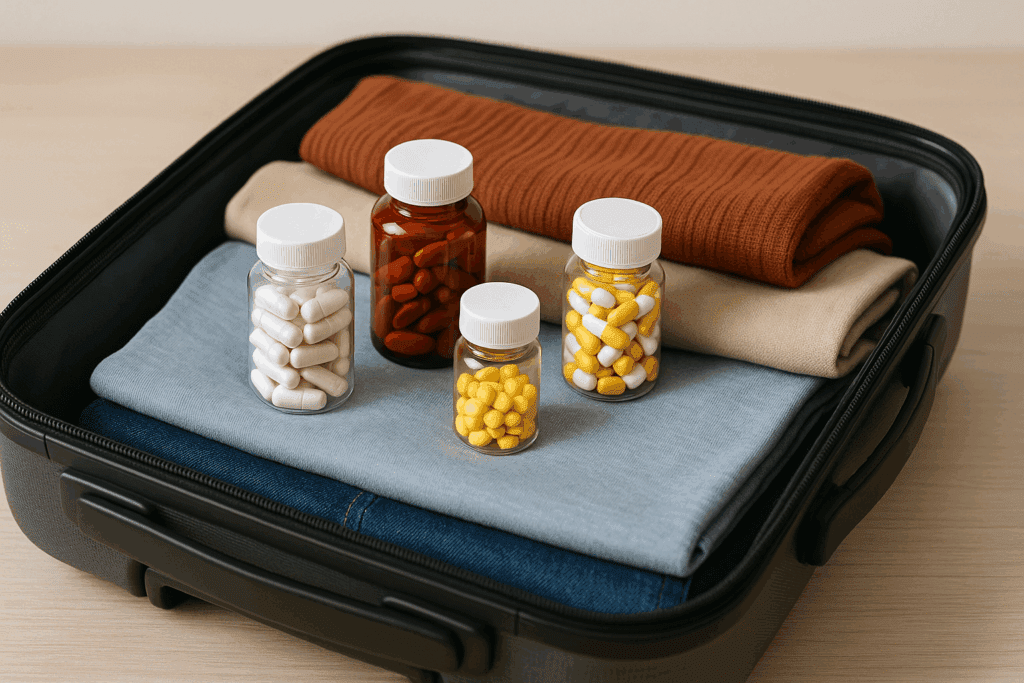
Travelers may bring prescription medication to Thailand when legally prescribed and carried in original packaging, with controlled substances limited to a 30-day supply. However, enforcement outcomes vary: identical documentation may be accepted or questioned depending on officer interpretation, shift protocols, and current inspection priorities at your port of entry.
- General prescriptions typically require original packaging and physician documentation
- Category 2 narcotics need Form IC-2 approval before departure
- Psychotropic medications require a physician certificate meeting specific criteria
- Documentation formatting and name matching affect inspection outcomes
Even with complete paperwork, travelers carrying controlled substances may face extended inspection or temporary holds while officers verify classification details.
Officer discretion, translation nuances, and real-time enforcement updates mean that preparation reduces—but cannot eliminate—entry uncertainty.
A traveler with approved Form IC-2, original packaging, and a physician letter was still held for 45 minutes when an officer questioned the license number format on the letter—a detail not specified in official guidelines.
Core Rules Overview
Thailand regulates imported medications under two distinct legal frameworks: the Narcotics Act B.E. 2522 (1979) and the Psychotropic Substances Act B.E. 2518 (1975). These laws establish separate classification systems, permit processes, and documentation requirements. Understanding which framework governs your medication is the first step in compliance.
Three agencies coordinate enforcement: Thai FDA (permits and classifications), Ministry of Public Health (regulatory standards), and Royal Thai Customs (port-of-entry inspection). No single agency provides universal clearance; travelers must satisfy all applicable requirements.
Medication Categories and Requirements
General Prescription Medications
Medications for hypertension, diabetes, allergies, and similar conditions typically enter Thailand without special permits when carried for personal use. Maintain these standards:
- Original, labeled container showing patient name, drug name, dosage, and prescribing physician
- Copy of valid prescription or signed physician letter detailing diagnosis and treatment plan
- Quantity reasonable for trip duration
Store medications in a clear, resealable bag within carry-on luggage to facilitate inspection. Keep documentation immediately accessible.
Category 2 Narcotics (Narcotics Act)
Category 2 narcotics include codeine, morphine, oxycodone, fentanyl, methadone, and similar opioid-based medications with recognized medical use but significant abuse potential. Import requirements:
- Approved Form IC-2 permit from Thai FDA obtained before travel
- Maximum 30-day supply calculated by prescribed daily dosage
- Original prescription and physician letter on official letterhead including license number
Processing time for Form IC-2 typically requires 2–4 weeks. Do not travel until written approval is received. Carry the approved permit, original prescription, and physician letter with your medication during entry.
Psychotropic Substances (Categories 2–4)
Psychotropic medications affecting mental processes—including methylphenidate, zolpidem, diazepam, and alprazolam—fall under the Psychotropic Substances Act. Import requirements:
- Physician certificate meeting six specific criteria (patient details, diagnosis, medication name and rationale, dosage instructions, total quantity, physician credentials with license number)
- Maximum 30-day supply calculated by prescribed daily dosage
- Original packaging with clear labeling
No advance permit is required for psychotropics, but documentation must be complete and physically presented during inspection. Digital prescriptions alone do not satisfy customs requirements.
Prohibited Substances
Category 1 narcotics and psychotropics are strictly prohibited for personal import. These substances are reserved for government-approved research or institutional use. Attempting to import Category 1 drugs without explicit pre-approved authorization carries severe penalties including lengthy imprisonment.
Documentation Requirements Checklist
Prepare these items before departure:
- Medication in original labeled containers matching passport name
- Signed physician letter on official letterhead including: patient name/address, diagnosis, medication name/strength/dosage/quantity, physician name/address/license number/contact
- Copy of valid prescription
- Approved Form IC-2 permit (Category 2 narcotics only)
- Clear resealable bag for organization during travel
- Printed copies of relevant Thai FDA drug classification references
All documentation must be in physical form. Names on labels, prescriptions, and permits must exactly match the traveler’s passport. Discrepancies trigger additional scrutiny.
Real Entry Scenario: Airport Inspection Process
Upon arrival at a Thai international airport, travelers proceed through immigration then customs. Most passengers use the green “Nothing to Declare” lane, but customs officers retain discretionary authority to inspect any traveler.
If selected for medication inspection, the typical sequence follows:
- Officer requests to examine carry-on luggage
- Traveler presents medications in original packaging
- Officer requests supporting documentation: prescription, physician letter, and permit if applicable
- Officer verifies drug name against Thai controlled substance catalogs
- If documentation is complete and quantities comply, traveler is cleared to proceed
In one documented case, a traveler with fully compliant documentation was asked to wait while the officer consulted a supervisor about the physician letter’s license number format—a verification step not required by written policy but applied at the officer’s discretion. Officers on different shifts may apply varying levels of scrutiny to the same documentation; morning inspections sometimes proceed faster than late-night arrivals when supervisory support is limited.
In another case, a traveler presented a fully compliant set of documents: approved Form IC-2, matching prescription, correctly calculated 30-day supply, and a physician letter with complete credentials. Despite this, the medication was temporarily held because the officer could not immediately match the drug’s brand name to the generic name listed in the Thai classification database. Although the issue was resolved after internal verification, the delay extended beyond one hour and occurred without any formal violation of written requirements.
Edge cases officers commonly encounter: physician letter missing license number, patient name mismatch between passport and prescription, quantity exceeding 30-day calculation, or medication classification ambiguity. Proactive declaration at the red “Goods to Declare” lane reduces ambiguity and demonstrates compliance intent when carrying controlled substances.
Common Mistakes Travelers Make
- Assuming foreign prescriptions automatically comply: Thai law requires specific documentation formats. A prescription from your home country alone does not satisfy regulatory requirements for controlled substances.
- Miscalculating the 30-day supply: The limit is based on prescribed daily dosage, not package size. “Take one tablet twice daily” means 60 tablets maximum for 30 days, not one bottle regardless of count.
- Confusing narcotic and psychotropic categories: Category 2 under the Narcotics Act is distinct from Category 2 under the Psychotropic Substances Act. Each references different drug lists and permit processes.
- Relying on digital documentation: Thai customs requires physical copies. Screenshots or email confirmations are not accepted during inspection.
- Subtle name formatting mismatches: A middle name included on your passport but omitted from the prescription label—or vice versa—can trigger additional verification steps even when identity is otherwise clear.
- Misinterpreting category classification: Assuming a medication’s regulatory category in your home country matches its Thai classification; the same active ingredient may fall under different legal frameworks requiring different documentation.
Why Travelers Still Get Stopped
Enforcement variability means that two travelers with identical documentation may experience different outcomes. One officer may accept a physician letter with a license number in numeric format; another may expect the full licensing authority name.
Classification ambiguity creates friction: a medication listed as “Category 2” under the Psychotropic Substances Act is legally distinct from “Category 2” under the Narcotics Act, yet travelers sometimes prepare documentation for the wrong framework.
Documentation inconsistencies—minor formatting differences, translation variations, or outdated reference links—can prompt officers to pause inspection for verification, extending processing time even when the traveler is ultimately cleared.
What Goes Wrong in Practice
Documentation gaps that trigger escalation:
- Physician letter missing license number or contact information
- Medication name on label does not exactly match physician documentation
- Quantity exceeds 30-day calculation even by a small margin
- Form IC-2 approval not yet received but traveler proceeds anyway
When paperwork is incomplete, officers may hold medication for further review, request supervisor consultation, or refer the case to law enforcement. The burden of proof rests entirely on the traveler to demonstrate legal authorization.
Risk Escalation Model for Non-Compliance
- Level 1: Minor documentation gap – Example: Physician letter missing license number. Typical outcome: Officer may allow correction via phone verification or request signed declaration. Medication usually released with warning.
- Level 2: Excess quantity – Example: 45-day supply of a Category 4 psychotropic. Typical outcome: Excess quantity confiscated; traveler may proceed with remaining 30-day supply. Written warning issued.
- Level 3: No permit for Category 2 narcotic – Example: Carrying oxycodone without approved Form IC-2. Typical outcome: Medication seized; traveler referred to police for investigation. Potential criminal charges under the Narcotics Act.
- Level 4: Prohibited substance – Example: Attempting to import a Category 1 narcotic. Typical outcome: Immediate detention, criminal prosecution, and potential imprisonment. No discretion for personal-use claims.
If You Are Traveling for Treatment
Medication compliance directly impacts admission logistics for rehabilitation or medical treatment programs in Thailand. Facilities conducting intake screening will verify that travelers have legally imported any required medications before beginning treatment protocols.
Coordinate with your treatment provider before departure to confirm: whether your medication is available locally, whether a Thai-licensed physician can prescribe an equivalent upon arrival, and whether your documentation satisfies both customs and clinical admission requirements. Understanding the admissions process helps align medication preparation with treatment timelines.
If your prescribed medication is unavailable in Thailand, discuss therapeutic alternatives with your physician before travel. Never assume a medication can be imported or prescribed locally without verification. Treatment planning should account for both regulatory compliance and clinical continuity, including structured care coordination and associated cost considerations.
Arriving without compliant documentation can delay admission: treatment facilities cannot begin protocols involving controlled substances until customs clearance is confirmed. In some cases, non-compliant travelers must postpone intake until documentation is resolved or alternative medications are arranged, extending the timeline for care initiation.
Pre-travel coordination with both your home physician and the Thai treatment provider ensures documentation meets dual requirements: customs inspection standards and clinical admission criteria. This includes verifying that physician letters include license numbers in the format Thai authorities expect and that medication quantities align with both the 30-day import limit and the facility’s intake medication policy.
Medication Import Comparison
| Substance Type | Permit Required | 30-Day Limit | Key Documentation |
|---|---|---|---|
| General prescription medication | No | No (reasonable personal use) | Original packaging, prescription copy, physician letter recommended |
| Category 2 Narcotics | Yes (Form IC-2) | Yes | Approved permit, original prescription, physician letter with license number |
| Psychotropics (Categories 2–4) | No (certificate required) | Yes | Physician certificate meeting six specific criteria |
| Category 1 substances | Yes (research-only) | N/A | Government research authorization |
Frequently Asked Questions
Can I bring ADHD medication to Thailand?
Yes, with restrictions. Methylphenidate and similar ADHD medications are classified as Category 2 psychotropics. You may bring up to a 30-day supply if accompanied by a physician’s certificate meeting all six required elements. Verify your medication’s classification using the official Thai FDA psychotropic list before travel.
What if my trip exceeds 30 days?
The 30-day limit applies to the quantity carried at entry. You cannot legally bring additional quantities of controlled substances for extended stays. Instead, consult a licensed Thai physician after arrival to evaluate whether a local prescription can be issued. Not all medications available abroad are approved or accessible in Thailand.
Do I need to declare medication at customs?
General prescription medications typically do not require formal declaration. However, it is strongly advisable to declare any narcotic or psychotropic substances at the red “Goods to Declare” lane. Proactive declaration demonstrates compliance intent and facilitates inspection.
Can someone else carry my medication?
No. Medication must be carried by the person for whom it is prescribed. Labels, prescriptions, and physician letters must match the traveler’s passport name. Allowing another person to carry your prescription medication—especially controlled substances—may be viewed as drug trafficking under Thai law.
Is tramadol allowed in Thailand?
Tramadol is available in Thailand but is regulated. Carry it in original packaging with a physician’s letter and prescription. Limit quantities to personal use (e.g., 30 days). Verify its current classification status via official Thai FDA resources before travel, as regulations may change.
- General prescriptions: original packaging + physician documentation recommended
- Category 2 narcotics: Form IC-2 permit mandatory before travel + 30-day limit
- Psychotropics (Categories 2–4): physician certificate with six specific criteria + 30-day limit
- Category 1 substances: strictly prohibited for personal import
- Verify drug classification using official Thai FDA resources before departure
- Carry all documentation in physical form; ensure names match passport exactly
- Declare controlled substances at customs to reduce inspection ambiguity
Legal Disclaimer: This guide is for informational purposes only and does not constitute medical, legal, or regulatory advice. Regulations governing medication import into Thailand are subject to change. Travelers are solely responsible for verifying current requirements with the Royal Thai Embassy, the Thai Food and Drug Administration, or other official authorities prior to travel. In case of discrepancy between this guide and official government documents, the official documents shall prevail.