Who Needs Residential Drug Addiction Treatment in Thailand?
Residential drug addiction treatment in Thailand fits people who keep returning to a drug after trying to stop, or who feel unwell or unsafe when they cut down on opioids, benzodiazepines or pills. It also fits drug use that comes with paranoia, depression or anxiety. Outpatient counseling at home usually suits shorter, milder use with a stable home life.
The Drugs We Treat and How Treatment Starts for Each
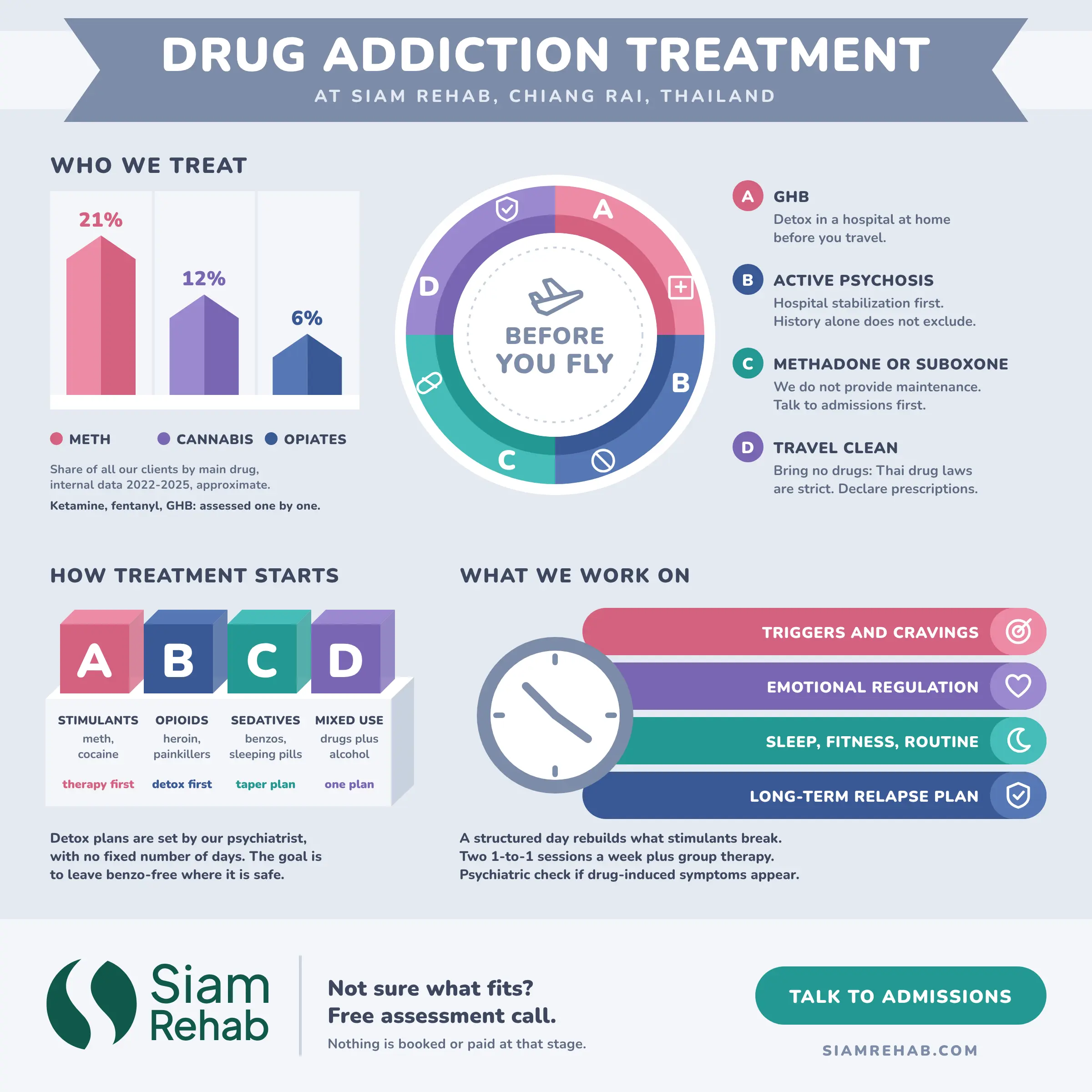
Find the drug you use most in the table first, because the drug decides what happens in the first days of treatment, and your history decides how long you stay. Clinical practice divides drugs by what stopping does to the body. Depressants such as opioids, benzodiazepines and Lyrica can cause dangerous withdrawal and need a medical plan, while stimulants such as meth and cocaine usually need therapy for cravings and sleep from the first week. One residential program covers every drug listed here, with a plan set for each person.
How treatment starts for the drugs our clients most often use, and where the work focuses:
“They’re pills from a doctor, so it can’t be addiction.”
Prescription drugs are often the hardest dependence to see from inside, because every early dose was legitimate. The pattern usually shows in the details: a second doctor, a refill requested early, a dose taken before the anxiety even arrives. Clinicians treat this as dependence in the same way as street drugs, and the plan simply starts with a safer taper. Drug use that runs together with heavy drinking is covered on the page about alcohol mixed with other drugs.
Do You Treat Ketamine, Ecstasy, GHB or Lyrica Dependence?
Ketamine, ecstasy, GHB and Lyrica dependence can all be treated in residential care, but each starts differently. Lyrica needs a supervised taper because stopping suddenly can be dangerous. Ketamine and ecstasy start with a medical and psychiatric check. GHB withdrawal can be severe, so detox usually happens in a hospital in your home country before travel, and the residential program follows.
What Goes Wrong When Drug Addiction Is Treated at the Wrong Level
If you take benzodiazepines, Lyrica or opioids every day, get a medical plan before you cut down. Doctors warn that stopping benzodiazepines or pregabalin abruptly after regular use can trigger seizures, and that a few days without opioids lowers tolerance, so going back to the old dose can cause an overdose. Seizures, confusion, slowed breathing or blue lips after stopping or restarting a drug need emergency medical care immediately.
Stimulants fail differently. After a meth or cocaine binge, the body crashes into long sleep, and the days that follow can feel like recovery. Clinical practice shows that cravings often return once sleep and appetite are back, usually around the second or third week, which is exactly when a short detox or a promise to stop has already ended. People then read the relapse as weak will, when the plan never covered the weeks that mattered.
Outpatient care can also feed the problem. A weekly session competes with six days in the same flat, the same contacts in the phone and the same route home past the dealer. Each slip after a session teaches the person that stopping does not hold, and after a few rounds many decide treatment does not work for them, when the level of care was the mismatch.
Can You Detox From Drugs at Home?
Detoxing from drugs at home is risky when the drug is a depressant taken daily, such as benzodiazepines, Lyrica, opioids or GHB, because withdrawal can bring seizures or a sudden drop in tolerance. Stimulant and cannabis withdrawal is rarely dangerous physically, but the crash makes relapse likely. A medical assessment before stopping decides which situation applies.
Outpatient, Detox Only or Residential Drug Treatment
Choose the level of care by how much of your drug use depends on where you live. When someone using daily tried outpatient counseling while keeping the same phone, flat and friends, a common pattern was a good week followed by a call that started it all again. The counseling itself was often sound. The supply was simply one message away, and every session ended at the same front door.
Outpatient counseling, detox only and residential treatment compared on access to drugs, medical safety, therapy time and what comes next:
When is residential drug treatment a better fit than outpatient care?
Residential drug treatment is a better fit than outpatient care when stopping causes withdrawal from opioids, benzodiazepines or pills, when earlier attempts ended within days, or when use comes with paranoia, depression or anxiety. A residential stay removes access and adds medical supervision. Outpatient care can work for shorter, milder use when home life is stable.
Siam Rehab, a licensed private residential addiction treatment center in Chiang Rai, Thailand, is the residential option on this list. The trade-offs are real: a flight, at least four weeks away from work and family, and an English-language program, in exchange for weeks without access to your usual supply.
To find out which level of care fits the drugs you use, request an assessment call with the admissions team. Nothing is booked or paid at that stage.
What Drug Rehab in Thailand Costs and How Long It Takes
How much does residential drug rehab in Thailand cost?
Residential drug rehab in Thailand at a program like this is priced by length rather than by drug: four weeks cost US$12,000, eight weeks US$22,000 and twelve weeks US$31,500, with VAT and a private en-suite room included. Medication used during detox or a taper, and any hospital care, are billed separately.
Program length follows your history, not the drug: four weeks usually fits a first treatment, eight weeks an earlier attempt that did not last, and twelve weeks repeated relapses or depression, anxiety or trauma alongside drug use. Longer stays are agreed after assessment. Before booking, ask your insurer in writing whether residential treatment abroad is covered, and check the rehab cost breakdown for what the fee includes.
How Siam Rehab Treats Drug Addiction
We treat drug addiction in a non-12-step residential program that takes no more than 18 clients at a time, so the team knows which drugs each person used, how and for how long. Therapy rests on cognitive behavioral therapy (CBT), motivational interviewing, dialectical behavior therapy (DBT), rational emotive behavior therapy (REBT) and relapse prevention, with EMDR for trauma when clinically appropriate.
Detox and tapers are planned by an external psychiatrist, who reviews your drug history, health and withdrawal risk before deciding on medication and pace. There is no fixed number of days: withdrawal differs widely between people, especially with benzodiazepines, and where it is medically safe, clients leave the program off benzodiazepines. Anyone who needs hospital-level care is stabilized at a hospital first, as the medical detox process explains.
For meth, cocaine and prescription stimulants, the work starts with sleep and a daily routine, because both break down during stimulant use. Each week then includes two one-to-one sessions with your counselor, weekday group therapy, physical fitness, and practice in spotting triggers, managing cravings and handling strong emotions without a drug. Every client has a private en-suite room, and phones are allowed for contact with family.
The program is licensed by Thailand’s Ministry of Public Health and jointly accredited by the Healthcare Accreditation Institute (HAI) and the National Institute for Drug Abuse Treatment and Rehabilitation (NISAD) of the Department of Medical Services. Since opening in 2014, more than 90% of our clients have completed their program. Before you leave, you get a written continuing-care plan and 12 weeks of weekly online sessions, described on the aftercare after residential treatment page, and we follow up at one, three, six and twelve months.
Steps to Start Drug Treatment
Admission moves from first contact to arrival in three steps, and the clinical review confirms that residential care is safe and suitable before any payment is made.
- Step 1: Send the admission form and take the first call. List every drug and medication you use, with doses, so the team can judge withdrawal risk early.
- Step 2: Complete the clinical assessment. The suitability review checks medical and psychiatric stability and agrees on detox, taper and program length.
- Step 3: Pay the deposit and book your travel. The deposit is non-refundable and secures your place; the admissions guide lists what to prepare before the flight.
Before You Travel: Thai Drug Law, Prescriptions and Maintenance Medication
Thai drug law shapes drug addiction treatment in Thailand before the first session, because travelers who carry drugs face prosecution and controlled medicines need paperwork. Travel with no illegal drugs at all. According to Thai embassy guidance, narcotic medicines classed in Category 2 need a permit from the Thai Food and Drug Administration, requested at least two weeks ahead and shown at customs. Ordinary prescription medicines are limited to a 30-day supply with a doctor’s letter. Tell admissions about every medicine before booking.
Three situations change the order of treatment. GHB dependence usually needs detox in a hospital at home before travel. Active psychosis needs hospital stabilization first, although a past episode or bipolar disorder does not rule anyone out on its own. People on methadone or buprenorphine (Suboxone) maintenance are generally not admitted, because the program does not provide maintenance medication; for them, a maintenance-focused program is usually the better fit.
What Are the Most Common Illegal Drugs in Thailand?
Methamphetamine pills, known locally as yaba, are by far the most commonly used illegal drug in Thailand, according to a national study by Thailand’s Office of the Narcotics Control Board reported in 2025. Ecstasy, crystal methamphetamine, opium and cocaine follow. For people in treatment, availability matters less than access from the treatment setting, which a rural residential program limits.
Settle the remaining doubts before they cost another month of use.
“Drugs are easy to find in Thailand.” They are, in some cities and nightlife areas. During treatment, relapse risk depends on access from the program, and a rural campus with supervised excursions and no unsupervised trips into town keeps that access low. The higher-risk moment is the return home, which is why the relapse plan is written before discharge.
“I can’t disappear for a month.” Many people take residential treatment as medical leave and describe it to an employer only as a health matter. Four weeks is the shortest program, and because phones are allowed, basic contact with home and work can continue.
“I don’t want a 12-step program.” Residential treatment does not have to mean Narcotics Anonymous. Non-12-step programs build recovery on CBT and relapse prevention, with no requirement to accept a higher power, and an aftercare plan can still include SMART Recovery or 12-step meetings at home if you choose them.
When families first raised treatment for a relative using pills, a frequent pattern was waiting for proof, because every bottle had a doctor’s name on it. Each conversation ended with a promise to cut down, and the dose kept rising. By the time the family acted, the first step had to be a supervised taper instead of a simple stop.
If you are still deciding whether your drug use needs residential care: write down every drug and medicine you took in the last two weeks, with amounts, and bring the list to an assessment call.
If you have decided to stop and want medical support from the first day: contact Siam Rehab’s admissions team to book a clinical assessment and agree on a start date.
Questions About Starting Drug Treatment
Is detox or a taper included in the program fee?
Medical supervision during detox or a taper is part of the residential program, and the four-week fee of US$12,000 covers the stay, therapy and accommodation. Medication used during withdrawal is billed separately, as is hospital care if a complication requires it. Ask for an estimate after the clinical assessment, since medication needs depend on the drug and dose.
Do you accept people on methadone or Suboxone?
People on methadone or buprenorphine (Suboxone) maintenance are generally not admitted, because the program is abstinence-based and does not provide maintenance medication. Maintenance therapy is a legitimate, evidence-supported approach, and a maintenance-focused program usually fits better for anyone who wants to stay on it. Admissions can talk through the options before any travel plans.
Can I bring my prescribed medication to Thailand?
Prescribed medication can usually be brought to Thailand, but controlled medicines need preparation. Thai embassy guidance says narcotic medicines in Category 2 need a Thai FDA permit applied for at least two weeks ahead, and other prescription medicines are limited to a 30-day supply in original packaging with a doctor’s letter. Confirm every medicine with admissions before booking.
Which country has the best drug rehabilitation?
No country has the best drug rehabilitation for everyone; the program matters more than the flag. Compare licensing and accreditation, how detox is supervised, which therapies are used, how many clients share the program, the full price and the aftercare plan. Thailand is often chosen for distance from home triggers and lower prices than private care in Western countries.
Will my employer find out about treatment?
Treatment records are confidential health information, and an employer usually learns only what you choose to share, such as a request for medical leave. Check your employer’s sick-leave policy and any confidentiality protections in your country before the assessment call, and ask how updates to family or referrers are handled.
What happens after I leave the program?
After the residential program ends, you leave with a written continuing-care plan and weekly online sessions for 12 weeks, with the option to continue with the same counselor afterward for an additional fee. The plan names local therapists, support groups and personal warning signs, because the first months at home carry the highest relapse risk.
Not Sure Which Treatment Fits the Drugs You Use?
Siam Rehab’s admissions team in Chiang Rai can review the drugs and medicines you take and tell you whether detox, a taper or residential therapy should come first.


