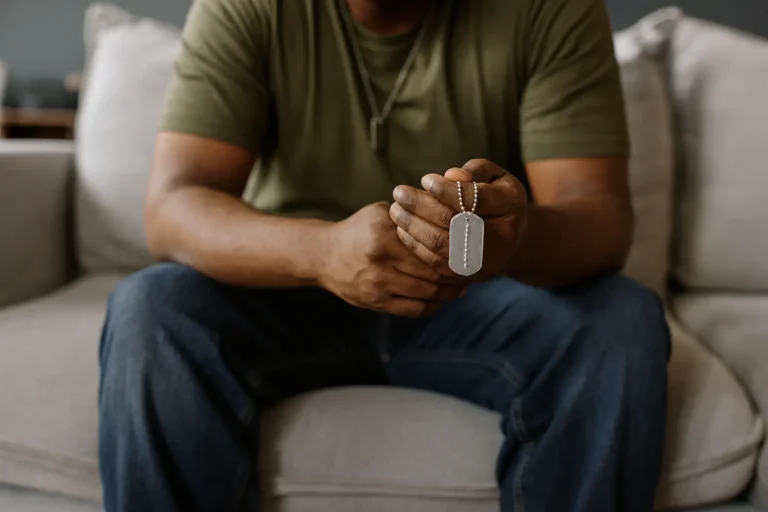
For many veterans managing service-connected pain, the trajectory follows a pattern that is both common and poorly understood: pain treated with opioids, function declining over months or years rather than improving, and substances that were prescribed as a solution becoming essential to get through an ordinary day. Veterans chronic pain addiction is a distinct clinical situation — not simply addiction that happens to occur alongside pain, but a reinforcing loop in which each condition makes the other harder to treat. This article covers the mechanism behind that loop, why standard addiction treatment environments frequently fail this group, and what integrated care actually involves when pain is part of the picture.
Chronic pain and addiction interact through a reinforcing biological loop in veterans: opioids prescribed for service injuries relieve pain initially but can increase pain sensitivity over time, while pain that goes unmanaged drives continued substance use. The VA’s own clinical research confirms that this pattern is common and that treating only the addiction — while leaving chronic pain unaddressed — produces predictable early relapse. Effective treatment addresses both simultaneously, in an environment designed for a nervous system already under significant load.
What Is the Connection Between Chronic Pain and Addiction in Veterans?
Chronic pain is both a cause and a consequence of opioid dependence in veterans. Opioids prescribed for service injuries relieve pain in the short term but can increase pain sensitivity over time through a process called opioid-induced hyperalgesia — the nervous system adapts by amplifying pain signals rather than quieting them. When substances are then removed, pain often intensifies before it improves. This is why addiction treatment that does not address chronic pain produces higher relapse rates in veterans than in the general treatment population: the original biological driver of use is still fully active at discharge.
Why Chronic Pain Is So Prevalent in Veterans — and Why Opioids Became the Default Response
The scale of chronic pain among veterans is larger than most people outside the VA system appreciate. Research shows that 48% of Operation Enduring Freedom and Operation Iraqi Freedom veterans presenting at the VA were diagnosed with a chronic pain condition within one year of service. More than half of male VA patients in primary care report chronic pain as a presenting concern. These figures reflect the physical reality of military service — musculoskeletal injuries, nerve damage, polytrauma, and the cumulative load of years of physical demand under extreme conditions.
Opioids became the standard clinical response not through negligence but through a combination of pharmaceutical marketing, limited alternatives, and system-level prescribing practices that the VA itself later acknowledged were unsustainable. Pharmaceutical companies heavily marketed opioid medications as non-habit-forming for years before the full risk became understood. By 2013, the situation had become serious enough that the VA launched the Opioid Safety Initiative — a system-wide program specifically designed to reduce harmful opioid prescribing and find better pain management approaches. VA research conducted as part of that initiative confirmed that VHA patients were twice as likely to die from accidental opioid overdose as the general population, and that the prescribing model that had produced this outcome required fundamental change.
This institutional history matters for veterans trying to understand their own situation. The dependence that developed was often not the result of misuse — it was the result of being prescribed a medication that was presented as appropriate treatment, within a system that was itself operating on incomplete information about long-term opioid risk.
A Marine veteran with chronic lower back pain from a deployment injury was prescribed opioids at a VA facility and maintained on them for two years. Each review appointment noted that pain scores had not improved. The clinical response was dose adjustment rather than approach reconsideration. By the time the connection between opioid escalation and worsening pain was identified, he had developed physical dependence that had not been part of the original treatment plan. His experience was not unusual — it was the pattern that prompted the VA’s own policy shift.
Opioid-Induced Hyperalgesia: When the Medication Makes Pain Worse
Opioid-induced hyperalgesia is the mechanism that explains what many veterans describe but struggle to name: the medication stopped working, pain spread beyond its original site, and stopping the opioids made the pain unbearable rather than better. Understanding what is actually happening biologically is important — not because the explanation resolves the problem, but because without it, the experience feels like personal failure rather than a predictable physiological response.
When opioids are taken over an extended period, the nervous system does not remain passive. It adapts. Specifically, it upregulates pain signaling pathways in a compensatory response to the opioid’s dampening effect. The result is a nervous system that has become more sensitive to pain than it was before opioid use began — an outcome that is the opposite of the therapeutic intention. VA and DoD clinical practice guidelines acknowledge opioid-induced hyperalgesia explicitly, describing it as a condition that presents with increased pain or increased pain sensitivity without a change in the underlying medical condition, and noting that some patients experience a paradoxical reduction in pain when opioids are discontinued.
In plain terms: some veterans who have been on long-term opioids will find that their pain actually improves after a managed withdrawal, not because their injury healed, but because the medication was amplifying their pain response. This does not happen in every case, and the early weeks of discontinuation typically involve intensified pain before any improvement. Knowing this in advance — that the initial worsening is a normal and expected part of the process, not evidence that stopping was wrong — changes how that period is experienced and navigated.
This is the section of the clinical picture that most standard addiction treatment programs do not address. Detox protocols are designed around substance removal. They are not typically designed to manage the pain amplification that follows long-term opioid use in someone with an underlying service-connected condition. The gap between what the program provides and what this specific situation requires is where most treatment failures in this population occur.
The PTSD-Pain-Addiction Loop
For many veterans, chronic pain does not exist in isolation. It sits alongside PTSD, traumatic brain injury, or both — and the interaction between these conditions is not simply additive. They reinforce each other through overlapping neurological pathways in ways that matter clinically for treatment.
PTSD and chronic pain share a nervous system sensitization mechanism. Hypervigilance — the persistent state of threat-readiness that characterizes PTSD — and chronic pain amplification both involve the same central sensitization processes. A nervous system in a chronic state of threat response lowers the threshold at which pain signals are perceived. Pain, in turn, sustains the physiological arousal that feeds hypervigilance. The two conditions lock the nervous system in an elevated state that makes both harder to treat independently.
Substances manage both simultaneously. An opioid or alcohol that dulls pain also reduces the hyperarousal of PTSD. A veteran who is using to manage chronic pain is often also using to quiet a nervous system that cannot easily quiet itself. This is why giving up substances is so difficult when both conditions are present — the substance is doing two distinct clinical jobs at once, and removing it leaves both problems unmanaged at the same time.
VA data shows that 2 in 10 veterans with PTSD also have a diagnosed substance use disorder. Among veterans with both PTSD and chronic pain — a combination that is common given the frequency of polytrauma in combat populations — the actual intersection is likely higher. For veterans whose PTSD is the primary presenting condition alongside substance use, the PTSD and addiction guide covers that dimension in detail. For veterans dealing with traumatic brain injury as an additional overlapping factor, the TBI and addiction page addresses that presentation specifically.
IF chronic pain, substance use, and PTSD or TBI are all present: treatment that addresses only one will leave the others operating as active relapse drivers. Integrated residential treatment that manages all three simultaneously is clinically indicated rather than sequential single-condition treatment.
IF chronic pain and substance dependence are present without confirmed PTSD: the pain-addiction loop still requires integrated treatment — standard detox followed by standard addiction rehab will typically not hold when ongoing pain remains the primary unmanaged driver of use. Siam Rehab’s veteran program addresses chronic pain management as a core component of treatment, not as a secondary concern to be handled after discharge.
Why Standard Rehab Environments Often Fail Veterans With Chronic Pain
Most addiction treatment programs are built for a different clinical situation: people whose physical discomfort is primarily withdrawal-related and resolves within weeks of abstinence. The schedule, the expectations, and the therapeutic model are calibrated for a nervous system that will stabilize as substances clear. For veterans with chronic pain and opioid-induced hyperalgesia, that stabilization does not follow the same timeline — and programs that do not account for this often create conditions that work against recovery rather than supporting it.
High-stimulation environments raise the pain floor for people with sensitized nervous systems. Busy schedules with little physical recovery time, expectations to push through discomfort without distinguishing between emotional discomfort that is therapeutically useful and physical pain that has a neurological basis, and limited clinical flexibility when pain fluctuates day to day — these features of standard high-volume programs are not neutral for this population. They increase the physical and cognitive load on a system that is already operating at capacity.
VA research comparing opioid and non-opioid treatment approaches for chronic pain found that opioids were not superior to non-opioid approaches in terms of pain control efficacy, but were associated with significantly worse side effects. This matters because it confirms that the non-opioid path is clinically viable — veterans can manage chronic pain without opioids. What it requires is a treatment environment and support structure designed to make that possible, not a standard rehab program that treats pain as a complication rather than a co-primary condition.
Clinical practice shows that veterans with chronic pain do better when treatment provides predictable low-stimulation routines that reduce daily physical and cognitive load, integrated medical oversight that manages pain during the treatment period rather than deferring it, and therapeutic pacing that adjusts to symptom fluctuation rather than holding to a fixed schedule regardless of how the person is presenting on a given day. These are not accommodations — they are the conditions under which the nervous system can do the work that recovery requires.
If pain has continued to worsen during or after opioid use, and prior treatment attempts have not held, the environment and approach need to change. Repeating the same type of program with greater effort will not produce a different outcome when the fundamental mismatch between the program’s design and the clinical situation has not been resolved.
What Integrated Treatment for Veterans With Chronic Pain Actually Involves
Integrated treatment for this presentation is structured around a sequence that most standard programs do not follow, because it begins from a different set of assumptions about what the person is dealing with.
The first phase is stabilization — medically managed detox that accounts for pain intensity, not just withdrawal symptom severity. Sleep restoration is a clinical priority from day one, because sleep disruption both amplifies pain and destabilizes mood in ways that undermine everything else. The goal of stabilization is not sobriety as an endpoint but a physical baseline from which therapeutic work can begin. In most veterans with significant opioid dependence and chronic pain, this phase takes longer than programs designed for substance-only presentations typically allow.
The second phase addresses pain and addiction together rather than sequentially. Non-opioid pain management in a clinical residential setting can include Acceptance and Commitment Therapy adapted for chronic pain — a VA-recognized approach that changes the relationship to pain rather than attempting to eliminate it; physical rehabilitation structured around sustainable activity rather than pushing through; psychiatric oversight where PTSD or depression is co-occurring; and sleep treatment sustained beyond the initial stabilization period. These are not complementary extras — they are the clinical content that determines whether the gains made in treatment survive contact with the demands of ordinary life after discharge.
The third phase is continuation planning that accounts for the reality that pain may still be present when treatment ends. Recovery plans that are contingent on pain resolving — that assume a person will be able to maintain sobriety once they are pain-free — consistently underperform compared to plans built around functioning with pain that is better managed but not eliminated. What changes in successful outcomes is not the disappearance of pain; it is the ability to respond to pain without substances being the only viable option.
An Army veteran in his early fifties had completed two outpatient programs over three years. Both times, pain management was not addressed during treatment — it was identified as something to coordinate with his GP after discharge. Both times, he relapsed within six weeks of completing the program, because the chronic pain that had initiated his opioid use was still fully present and completely unmanaged. His third treatment attempt took place in a residential program that included pain management as a core clinical component. The early weeks were physically harder than his previous attempts because the opioid-induced hyperalgesia made initial discontinuation more intense. By week five, his baseline pain scores had improved compared to his worst point on long-term opioids. He described the previous two experiences as treating the symptom while leaving the cause in place.
For veterans exploring whether VA coverage applies to residential treatment overseas for service-connected conditions including chronic pain that has contributed to substance use, the VA Foreign Medical Program guide covers the coverage criteria and process in detail.
Frequently Asked Questions
Why do so many veterans become addicted to pain medication?
Veterans experience chronic pain at significantly higher rates than the general population — 48% of OEF/OIF veterans were diagnosed with a chronic pain condition within one year of VA service. Opioids were prescribed at scale for decades as the standard clinical response to service injuries, often before the full risk of long-term use was understood. The VA’s 2013 Opioid Safety Initiative was a direct institutional response to recognizing that this prescribing pattern had produced widespread dependence.
What is the connection between chronic pain and addiction in veterans?
Chronic pain drives substance use as a management strategy, while long-term opioid use can increase pain sensitivity over time through opioid-induced hyperalgesia. The result is a loop: pain drives use, use worsens pain, increased pain drives continued use. For veterans with co-occurring PTSD, substances also manage hyperarousal symptoms simultaneously, creating a dependence that addresses two distinct clinical problems at once.
How is chronic pain treated in veterans without opioids?
VA research confirms that non-opioid approaches are not inferior to opioids for chronic pain management and carry significantly fewer side effects. Evidence-based non-opioid options include Acceptance and Commitment Therapy for pain, physical rehabilitation, sleep treatment, and psychiatric management where PTSD is present. These approaches require a structured clinical environment to implement effectively — they are not simply lifestyle adjustments.
Can veterans get addiction treatment covered by the VA?
Treatment for service-connected conditions, including substance use disorders that developed from opioids prescribed for service injuries, may qualify for VA coverage including under the Foreign Medical Program for veterans seeking treatment overseas. Eligibility depends on service-connection status and the specific presentation. The VA Foreign Medical Program guide covers the criteria in practical detail.
What is opioid-induced hyperalgesia?
Opioid-induced hyperalgesia is a condition in which long-term opioid use causes the nervous system to become more sensitive to pain rather than less — the opposite of the intended therapeutic effect. It presents as pain that spreads beyond its original site, increased sensitivity to stimuli that were previously tolerable, and pain that worsens when the opioid dose increases. Some people experience a paradoxical improvement in pain when opioids are discontinued under medical supervision.
How does PTSD make chronic pain worse?
PTSD and chronic pain share overlapping nervous system pathways. The hypervigilance of PTSD keeps the nervous system in a state of heightened arousal that lowers the threshold at which pain is perceived. Pain, in turn, sustains the physiological activation that feeds hypervigilance. The two conditions amplify each other through central sensitization mechanisms, which is why treating only one while leaving the other unaddressed produces limited improvement in either.
What does integrated pain and addiction treatment look like for veterans?
Integrated treatment addresses pain and addiction simultaneously rather than sequentially. It includes medically managed detox that accounts for pain intensity, non-opioid pain management as a clinical component throughout treatment, psychiatric oversight where PTSD or depression is co-occurring, and discharge planning built around managing pain without substances rather than contingent on pain resolving. The treatment environment matters as much as the clinical content — a low-stimulation, medically attentive setting reduces the physical load on a sensitized nervous system.
Is overseas rehab an option for veterans with chronic pain?
Yes. Veterans seeking residential treatment overseas for service-connected conditions may qualify for VA coverage under the Foreign Medical Program. Beyond the coverage question, overseas residential settings provide the environmental separation that is particularly relevant when the home environment is saturated with chronic stress, familiar pain cues, and social contexts associated with substance use. The physical and environmental change supports early recovery in ways that proximity-based outpatient programs cannot replicate.
If the pattern described in this article is recognizable — pain that worsened during opioid treatment, treatment attempts that have not held, or substances that are managing both pain and PTSD symptoms simultaneously — a clinical assessment call is the clearest next step. Siam Rehab’s veteran program addresses chronic pain management as part of addiction treatment, not as a follow-up task. Contact the admissions team through the form on this page – the call takes fifteen minutes, requires no commitment, and will clarify whether this program is the right fit for the specific situation.


